


In Part 1 of our series, we grounded ourselves in the definition of the Science of Reading – a body of research that helps us understand how students learn to read and what instruction supports that process most effectively. The complex, validating, yet often confusing conversation around the Science of Reading has many educators reflecting on their own teaching practices. If you’ve found yourself wondering, questioning, or even rethinking parts of your literacy instruction, you’re not alone! You’re doing exactly what strong educators do, and that kind of reflection is where the real growth happens – for teachers and for students.
Now let’s put it into action: What does the Science of Reading actually look like in the classroom?
Because the Science of Reading isn’t a program or a script, it doesn’t show up as one specific routine. Instead, it shows up in how we structure our literacy block, how we prioritize and embed literacy skills across the day, and how we create opportunities for students to apply their learning in meaningful ways.
What SoR-Aligned Instruction Looks Like in Your Classroom
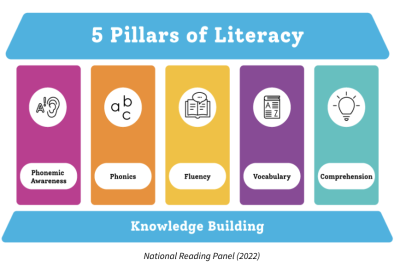
The Science of Reading is put into practice in actual classrooms through the five pillars of literacy:
- Phonological Awareness
- Phonics
- Fluency
- Vocabulary
- Comprehension
These pillars all work together to build strong, skilled readers, and are all strengthened by one essential foundation: knowledge-building.
Within each pillar of literacy, instruction must be intentional, structured, and predictable– not because learning should feel rigid, but because consistency and reliability help students build independence and confidence. Students need:
- Explicit teaching of grade-level standards during whole-group instruction
- Opportunities for independent application to practice and transfer skills
- Targeted support through extended, tiered classroom instruction
Knowledge-Building: The Foundation for Everything
All teachers have heard it said that students don’t just learn to read – they read to learn! Comprehension depends heavily on what students already know about the world around them, so before we even get to the five pillars, it’s important to recognize what supports them all: knowledge and language.
What this looks like in your daily instruction:
- Content-rich texts in science, social studies, and literature
- Explicit vocabulary instruction tied to those topics
- Opportunities to talk, write, and think deeply about ideas
- Repeated exposure to complex language and concepts
Knowledge builds over time, and the more students know, the easier it becomes to understand new texts. This is why literacy instruction cannot live in isolation from content areas.
Building the Reading Brain
Phonological awareness and phonics are the foundation of word recognition, and they must be taught explicitly and systematically.
What this looks like in your daily instruction:
-
- Daily routines for blending and segmenting sounds
- Explicit instruction of letter-sound relationships and spelling patterns
- Opportunities for students to decode (read) and encode (spell) words
- Skills taught in a clear, cumulative sequence
- Small-group instruction that reteaches or reinforces specific skills
Instruction is focused and intentional rather than being scattered across multiple disconnected activities. The goal is not just exposure – it’s accuracy and automaticity to build toward fluent reading.
Fluency: Bridging Word Reading and Comprehension
Fluency plays a critical role in reading development. Fluency relies on automaticity, but is not limited to simply automatic reading! Fluency includes using the meaning of what you are reading to change your voice, scoop words together in phrases, and overall read with expression. When students read accurately, at an appropriate pace, and with expression, they free up mental energy for comprehension.
Fluency instruction should be:
- Modeled regularly by the teacher
- Practiced through repeated reading
- Connected to texts that students can read with high accuracy
What this looks like in your daily instruction:
- Teacher-supported shared reading that models phrasing and expression
- Students rereading short passages to build confidence and smoothness
- Partner reading or choral reading routines
Fluency is not about speed alone – it’s about reading that sounds like talking to support comprehension!
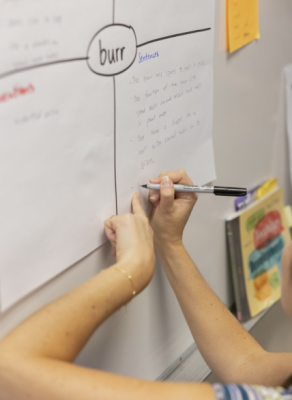
Vocabulary: Unlocking Meaning
Vocabulary is one of the keys to reading comprehension, as students cannot understand texts if they don’t understand the words – especially domain-specific and academic vocabulary.
A Science of Reading–aligned classroom builds vocabulary through:
- Explicit instruction of key words
- Teaching words in meaningful contexts, not isolation
- Repeated exposure to new words across reading, writing, and discussion
What this looks like in your daily instruction:
- Teachers pre-teaching critical vocabulary before reading
- Students using new words in speaking and writing
- Word walls or visuals that support understanding
Vocabulary instruction is most powerful when it’s connected to knowledge-building – when students learn words as part of learning about the world.
Reading Comprehension: The Goal of It All
Even with the increased focus on foundational skills within the Science of Reading, comprehension remains the ultimate goal of reading instruction, and it deserves just as much intentional attention, planning, and instructional time as the skills that support it! Research shows that comprehension develops alongside the other pillars of literacy, like phonics and fluency. But decoding alone does not guarantee understanding! Students also need:
- Background knowledge
- Opportunities for discussion
- Time to think deeply about texts
Teachers often see this clearly: students who decode well may still struggle when texts become more complex. That’s why comprehension must be intentionally woven into daily instruction.
What this looks like in your daily instruction:
- Asking students to think deeply and make claims about the text (infer themes, analyze characters, consider text structure and author’s decisions)
- Structured discussions that require evidence-based thinking
Writing about reading to clarify and deepen understanding
Bring the Pillars Together in the Classroom
When the Science of Reading is implemented well into classrooms, these pillars are not taught in isolation – they are integrated across the day. Students need dedicated time for explicit instruction in word recognition and writing, daily opportunities to engage in reading real texts, and time for rich discussion and meaning-making.
What this looks like in your daily instruction:
- An explicit phonics lesson followed by reading and writing that apply the same skill independently
- Fluency practice connected to meaningful texts
- Vocabulary introduced during a read-aloud and used throughout the day
- Comprehension built through discussion, writing, and content-rich texts
This is what Science of Reading–aligned instruction looks like- not flashy or new, but structured, consistent, and deeply intentional.
Looking Ahead
When we understand how the five pillars work together, we can design instruction that aligns to the Science of Reading and truly meets students’ needs.
In Part 3, we’ll extend this work beyond the classroom and explore how families and caregivers can support reading development at home in simple, meaningful ways.
📸 How are you bringing the Science of Reading to life in your classroom?
We’d love to see your routines, anchor charts, and student work- tag us @litpartnersca!
Here are some additional resources that can provide support as you dive deeper into the Science of Reading:

Shifting the Balance: 6 Ways to Bring the Science of Reading into the Balanced Literacy Classroom


A Fresh Look at Phonics, Grades K-2: Common Causes of Failure and 7 Ingredients for Success